← Indicators  /  Nomad TF Conditions MT5
NEW · MT5 INDICATOR

Nomad TF
Conditions v1.0

A market regime detector that answers the question that actually matters before any trade: "Is the playground safe for my strategy right now?" Self-calibrating across timeframes, immune to fixed thresholds, and direction-agnostic.

6
Market Metrics
Z-Score
Self-Calibrating
6 TFs
M1 — D1 Scan
Cost
Veto Gate
Platform
MetaTrader 5
Type
Regime Dashboard
Markets
FX · Metals · Indices · Crypto
Use
EA filter · Manual scan
▸ Price
$200
one-time · lifetime license
Get This Indicator → 📖 View Manual
MT5 .ex5 file — instant delivery
Full parameter reference manual
All symbols · all timeframes
iCustom-ready for your EAs
Lifetime updates — free
Direct Telegram access
§ 01 — Live on a chart

A scan of M1 through D1, on every tick.

XAUUSD H1 with the dashboard panel — six timeframes ranked simultaneously, each with a current condition rating and a 0–100 score. "Best TF Now" highlights where structural conditions are statistically the cleanest at this moment.
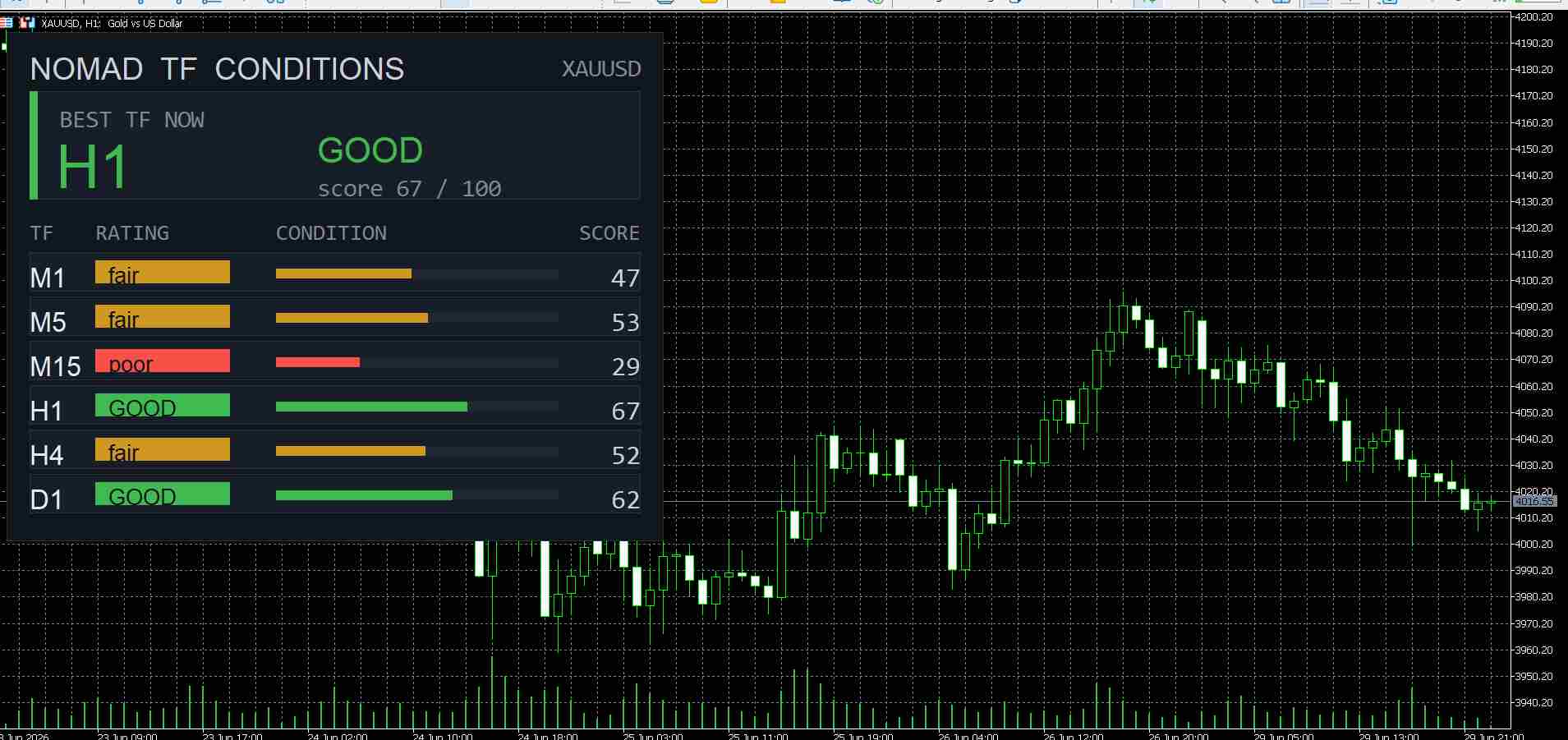
Nomad TF Conditions on XAUUSD H1 — dashboard panel showing M1 to D1 ratings
XAUUSD · H1 chart · M1 to D1 simultaneous scan · GOOD / FAIR / POOR grading Live dashboard · drag-to-position
§ 02 — Core philosophy

Environment matters more than direction.

Most retail trading systems fail because they apply a trending strategy to a choppy market — or a mean-reversion strategy to a breakout market. Instead of trying to predict whether price is going up or down, this indicator measures the mathematical quality of the playground across every timeframe simultaneously.

// PIPELINE [Raw Market Properties] (MMI, FDI, SNR, Cleanliness, Opportunity, Progress) │ [Dynamic Self-Calibration] ──▶ Compares current data to its own timeframe history │ [Cost-Gate Veto Floor] ──▶ Demotes TFs where transaction costs eat the moves │ [Regime Classification] ──▶ Outputs: GOOD, FAIR, or POOR
§ 03 — Three pillars of the logic

Why fixed thresholds don't work.

What is "choppy" for EURUSD is "smooth" for Gold. A single hard-coded threshold catastrophically fails across asset classes and across volatility regimes. This indicator is built around three structural principles.

I.
Context over Absolutes
Rejects fixed thresholds entirely. Uses dynamic z-scores to ask: "Are conditions unusually stable, smooth, and structured for this specific asset on this specific timeframe right now?" Self-calibration through Welford's algorithm for numerically stable rolling statistics.
II.
Pure Condition vs. Cost
A low timeframe might show beautiful structural waves — but if those waves are smaller than the spread plus commission, the moves are untradeable. The cost gate steps in as a veto floor, demoting the grade to POOR rather than polluting the underlying score.
III.
Direction Agnostic
Completely ignores whether the market is bullish or bearish. The only question it answers: is the market printing clean, efficient, repetitive swings — or random, chaotic noise? Visual hysteresis through confirm-bars logic prevents the dashboard from flickering between states.
§ 04 — Six raw metrics

What's actually being measured.

Every grade rests on six independent market properties. Each is z-scored against its own rolling history, logistically scaled, then combined into a weighted score — never a geometric mean that would double-penalise a single poor metric.

MMI Market Meanness Index Median-cross counting. Determines whether the asset is trending or mean-reverting on the timeframe in question.
FDI Fractal Dimension Index Hurst exponent variant. Uses high/low ranges over split periods to detect persistence vs. random walk behaviour.
SNR Signal-to-Noise Ratio Average physical length of validated swing legs against raw bar high-low noise. Filters out chop dressed up as trend.
Cleanliness Swing Efficiency Compares total price path travelled against net directional swing length. An excellent whipsaw filter.
Opportunity Setup Frequency Counts qualified legs. Ensures you don't trade a "perfect" market that only prints one usable move per week.
Progress Net Efficiency Measures one-way progress vs. round-tripping over the analysis window.
§ 05 — How to use it

An operational filter, not a signal generator.

This indicator does not generate buy or sell alerts. It tells you when and where your existing strategies are statistically likely to succeed.

▸ 01 · For EA developers
Dynamic on/off gate for trading bots
Plug into your EA via iCustom() to dynamically toggle execution loops. Restrict trend/breakout EAs to GOOD-graded timeframes. Cut scalping EAs when the cost gate fires during spread widening.
▸ 02 · For discretionary traders
Timeframe selection dashboard
Instantly see where the clean structural expansion is actually happening. If H1 is a chaotic mess (POOR) but M15 is printing beautifully smooth legs (GOOD), you know exactly where to shift your focus.
▸ 03 · For strategy switching
Match your style to the regime
High SNR + High Cleanliness → classical swing trading, S/R validation, chart patterns. Low score / POOR → mean-reversion only, tight ranges, or stand aside and preserve capital entirely.
§ 06 — Independent technical review

Reviewed line-by-line.

The source code was submitted to an independent architectural review focused on quantitative correctness and MetaTrader 5 implementation quality.

9.2/10
▸ Technical Review · Architecture & Statistics
Institutional Grade · Excellent

"Exceptionally well-thought-out, institutional-grade MQL5 indicator. Instead of trying to predict price direction, it solves a much harder problem that ruins most algorithmic strategies: market regime detection. It treats market structure mathematically and dynamically rather than relying on arbitrary, static lagging indicators."

Key points called out in the review:

  • Self-Calibration via Dynamic Z-Scores — what is "choppy" for EURUSD is "smooth" for Gold. Dynamic calibration adapts to the current volatility environment per timeframe.
  • Cost Gate Veto Concept — a brilliant structural design. Lower timeframes may show beautiful trends, but spread + commission can eat the moves. Cost as a veto floor, not a linear tax.
  • Arithmetic vs. Geometric Mean precision — weighted arithmetic mean on logistic-scaled z-scores. A geometric mean would double-penalise a single poor metric.
  • Memory and performance optimisation — caches baseline calculations via InpBaselineSec, uses Welford's algorithm for stable running mean and variance.
  • Flawless visual hysteresisInpConfirmBars prevents the UI from flickering on volatile candles.

Trade the environment,
not just the chart.

Get the regime detector that tells you exactly when conditions favour your strategy — and exactly when to stand aside. iCustom-ready for any MT5 EA.